
An AI Employee Is Not a Chatbot, and the Difference Is the Whole Point

You have probably already tried a chatbot. Most local businesses have — a small widget in the bottom-right corner of the website, installed with good intentions, answering three questions a week and forwarding the rest to an inbox nobody opens on a Sunday.
So when someone turns up selling you an "AI Employee" with a first name and a photograph, the reasonable first thought is that this is the same widget wearing a nametag.
That's a fair suspicion, and it deserves a straight answer rather than a brochure. Here is where the difference actually sits — four places, none of which are about the technology underneath.
First, what a chatbot is genuinely good at
A chatbot answers questions on a web page for someone who has already found you and is willing to type. That is a real job. Done well, it deflects a share of the "what time do you close" traffic that would otherwise ring the front desk.
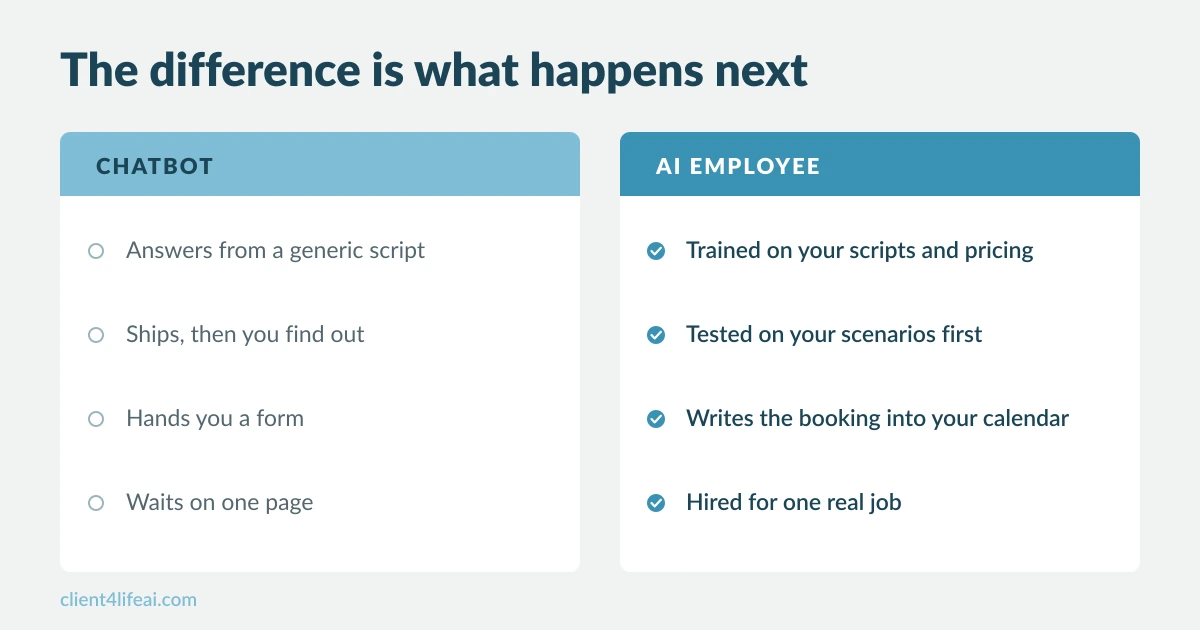
But look closely at the scope. It waits. It waits on one page, for one kind of person, in one channel, and it answers from a script that someone wrote before they knew anything about your business. When the conversation reaches the point where something has to actually happen — a slot held, a record updated, a callback scheduled — it hands you a form or an email address.
That is the ceiling, and it's a ceiling of design, not of effort. Everything below is about what changes when you move above it.
Difference one: it is trained on your business, not on a script somebody else wrote
A generic bot knows what a business is. An AI Employee knows what your business is.
The build starts with the material that only you have: your call scripts, the objections your team hears every week, your services, your pricing, and the fifty questions your front desk answers most. That last one is the unglamorous item on the list and it carries more weight than anything else. Every operation has a set of questions that consume a receptionist's morning — what you do and don't accept, how the first appointment works, what the deposit is, whether you can see someone this week. Those answers are specific to you and wrong everywhere else.
Your side of that is a 20-minute kickoff call and roughly 30 minutes of homework from you or a member of staff. That's the whole commitment. Everything after it is build work, and it is the thing you are actually paying for.
Difference two: it is tested against your real scenarios before a customer hears it
This is the step nobody puts on a feature list, and it is the one to ask about.
Before an AI Employee goes live, it gets run against your real call and enquiry scenarios — the awkward ones, the ones where the caller asks something the script didn't anticipate, the ones where the answer is "that needs a person." Testing is part of the setup, not a separate project invoiced later.
A chatbot ships and then you find out. An AI Employee is found out first, in private, where the cost of a wrong answer is a correction rather than a lost customer. If a vendor cannot tell you how they test before launch, you are buying the first version of something and paying to be its trial run.
Difference three: it takes actions, not just turns
Here is the difference you can see from the outside.
A chatbot holds a conversation. An AI Employee finishes one. It connects to the CRM, calendar and phone system you already run, and it writes the outcome into them — the appointment goes into the real schedule, the contact record gets updated, the follow-up gets queued.
The tell is in how the conversation sounds. Someone asks whether anyone is free tomorrow, and a real answer comes back before the ask: 9:15am or 2:40pm. Two actual times, from the actual calendar, offered before anybody is asked to hand over a name and a number. Compare that to a form demanding your details before it will tell you anything, and you can hear the difference without knowing a single thing about how either one is built.
That distinction travels across every industry we work in. A portal lead reaching a real estate broker expires in minutes. A funding applicant submits to several lenders in the same afternoon and the first one to make contact ends up with the file. In law, the first firm to answer usually takes the matter. In each case the win condition isn't a good conversation — it's a conversation that ended with something written down somewhere.
Speed is why that matters more than it looks. James Oldroyd's lead-response research, covering more than 100,000 call attempts, found that responding within five minutes rather than thirty made a business roughly 100 times more likely to make contact, and 21 times more likely to qualify the lead. Thirty minutes — not thirty hours. An enquiry that arrives at 5:15pm on a Friday and reaches a voicemail is, by Monday, closer to a stranger than a lead.
Difference four: it is hired for one job, not for everything
The last difference is the one most people miss, and it's structural.
There is no single do-everything bot. Each AI Employee is scoped to one real job description, the same way you would scope a hire:
- Ava answers the call you missed and runs the booking conversation end to end.
- Tessa keeps a warm lead warm for the weeks or months it actually takes them to decide, across voice, SMS and email.
- Grant works the contacts already sitting cold in your CRM — the list you have already paid for.
- Russell handles the interactions after the sale, where churn is actually decided.
- Kai fields the repetitive procedural and insurance-related questions that eat the front desk's morning.
- Wendy builds the automations specific to your operation that no off-the-shelf product ships with.
- Matt runs the promotional work that keeps the pipeline full enough for the rest of them.
Scope is what makes each one good. Ava's entire job is the booking conversation, which is why she handles the version where the caller changes their mind twice. A bot asked to do all seven jobs does all seven at the same shallow depth, and the depth is the product.
They aren't sealed off from each other, either. Hire several and they share context, so a lead Ava books and Tessa chases arrives at Russell with the history intact rather than starting cold.
What it does not do
The honest limits, because they're what makes the rest credible.
It does not replace your front desk. It takes the overflow, the after-hours calls and the repetitive scheduling work, so the people you employ spend their day on what genuinely needs a person — including the customer standing in front of them.
It hands over rather than improvises. Anything complex, anything clinical, anything past its brief goes to your team instead of being guessed at.
And if your phone gets answered — if you genuinely don't have a miss problem — this isn't for you, and we'd rather say so now than after you've signed something.
Four questions to ask anyone selling you one
Useful regardless of who you buy from, including us:
- What exactly are you training it on, and what do you need from me to do it? A vague answer here means a generic bot.
- How do you test it before a customer hears it, and is that included? If testing appears as a line item later, it wasn't in the plan.
- Which of my systems does it write to? "Integrates with" can mean it sends an email. Ask what it changes in the calendar and the CRM record.
- What single job is this one hired for? If the answer is "everything," you're being sold a widget with a name.
Where to go from here
If you want the mechanics rather than the argument, the full roster of AI Employees and what each one is hired to do sets out the job descriptions in detail, and the questions we get asked most, answered plainly covers the ones this post skipped — including whether you could just build it yourself, which has a shorter and more honest answer than you'd expect.
If you want to know whether the math works before you talk to anyone, put your own numbers into the missed-call calculator. Every input is yours to change and every source is published beside it.
And if you'd rather hear one, book a demo and listen to it handle a real call.
Frequently asked questions
What is an AI Employee? A trained digital system that performs a specific job autonomously — using AI voice and texting paired with automations — 24 hours a day. It is hired for a role, not installed as a feature. Ava books appointments. Grant works your dormant database. Each one is scoped to a real job description.
How is an AI Employee different from a chatbot? Four differences, and none of them are about the technology underneath. It is trained on your business, your scripts and your objections. It is tested against your real scenarios before it goes live. It takes actions in your CRM, calendar and phone system rather than only holding a conversation. And it is hired for one job across voice, SMS and email, rather than waiting on a page for someone who already found you.
Does an AI Employee replace my staff? No. The goal is enhancing your team, not replacing it. It absorbs the repetitive, high-volume and out-of-hours work so the people you employ spend their day on the things that genuinely need a person.
What happens when someone asks it something complicated? It hands over to your team rather than improvising. Anything past its brief goes to a person instead of being guessed at.
Which industries does this work for? Any operation where the phone ringing out is the same thing as revenue walking. In practice that covers dental and med spa practices, law firms, business coaches, lenders, real estate brokers, insurance brokers and general business owners — the mechanics are the same, only the vocabulary changes.