

How Much Revenue Is Your Dental Practice Losing to Missed Calls?
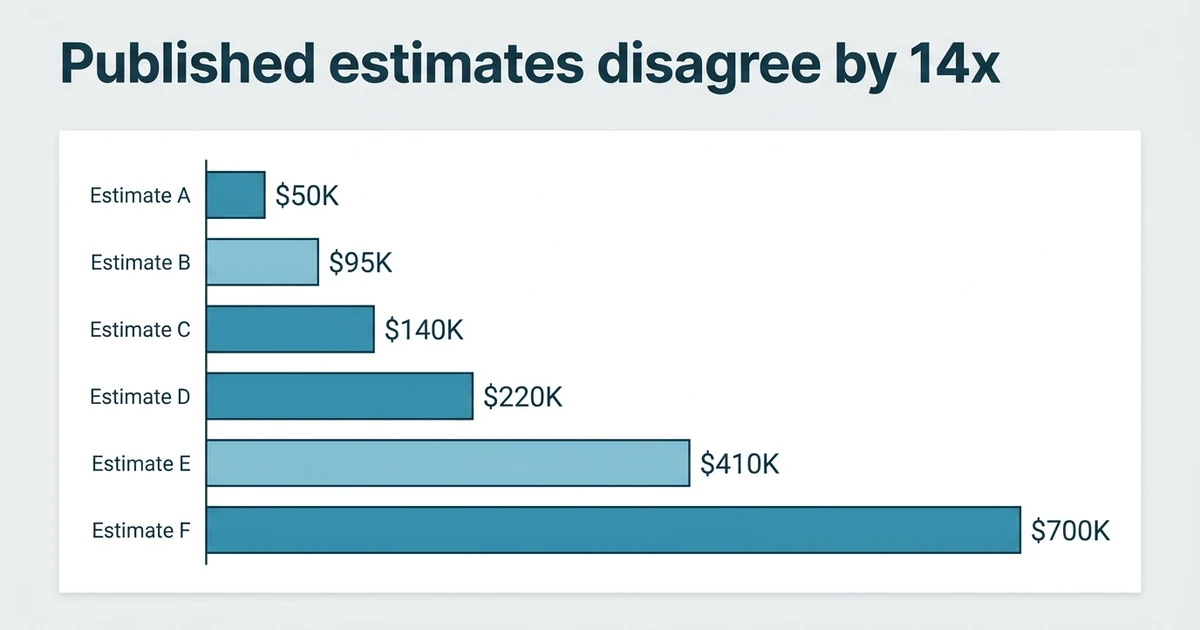
Search that question and you'll get answers between $50,000 and $700,000 a year. Same industry, same question, estimates that differ by a factor of fourteen.
They can't all be right. Most of them don't show their work, which is why we're going to show ours — every input, every source, and the places where the industry's favorite statistics fall apart under inspection.
Why every article gives you a different number
Annual missed-call loss is not a measured figure. It's the output of a formula with four inputs:
- How many calls you miss
- What share of those are new-patient calls
- What share of new-patient calls would have booked
- What a new patient is worth
Change any one and the headline number swings by six figures. Most articles in this category disclose one input, imply two, and quietly skip the fourth. Several cite each other. When we traced the most-repeated statistics back, a few had no original study behind them at all.
So here are the four numbers, with sources, including the ones that didn't hold up.
The four inputs, sourced
1. Unanswered call rate: 31–38%
Peerlogic analyzed 4,280 calls across 26 dental practices and found 38% went unanswered (February 2026). Patient Prism, scoring 11.5 million calls across 8,280 dental and DSO locations, found 31% of callers hung up before reaching a person (2025).
Worth stating plainly: both companies sell call software. Their samples are practices that already installed call tracking. These are the two largest dental call datasets that publish their methodology, and they're the best available — but they are not independent audits, and we're not going to present them as if they were. You'll also see a "Dental Economics survey" quoted across this category. We went looking for it and couldn't find the original article, so it isn't cited here.
2. New-patient share of inbound calls: roughly 25–35%
This is the input almost everyone skips, and skipping it is what inflates the big headline numbers. A missed call is not the same thing as a missed new patient. Most inbound calls are existing patients — rescheduling, asking about a bill, chasing an insurance question. Valuable, but not new production.
3. New-patient call to booked appointment: 21–25%
Patient Prism reports 21 booked appointments per 100 patient calls. Peerlogic puts new-patient call conversion at 25.2%, against 55.8% for existing patients. Two different vendors, two different customer bases, close enough to be useful.
Note what this means: even the calls you do answer book about a quarter of the time. A missed call isn't a lost patient — it's a lost 23% chance at one.
4. What a patient is worth: $685 a year, $4,500–$6,500 lifetime
The American Dental Association's Health Policy Institute puts average annual per-patient dental expenditure at $685, drawn from Medical Expenditure Panel Survey data. At seven to ten years of retention, that derives to a lifetime patient value of roughly $4,500–$6,500.
You'll see "$300–$600 lifetime patient value" quoted in this category, including in our own earlier material. That figure is wrong as stated. It's in the right range for the immediate production of a single first visit — Peerlogic puts an average new-patient visit at $350 — but it is not lifetime value, and the two get conflated constantly. Lifetime value is roughly ten times larger.
The math, worked out
Take a practice missing 10 calls a week. Here's the full derivation:
| Step | Calculation | Result |
|---|---|---|
| Missed calls per year | 10 × 52 | 520 |
| New-patient calls among them | 520 × 30% | 156 |
| Would have booked | 156 × 23% | 36 patients |
| First-year production | 36 × $685 | ~$24,700 |
| Lifetime value | 36 × $4,800 | ~$173,000 |
Two honest observations about that table.
The first-year number is about $25,000 — an order of magnitude below what most articles in this category advertise. The six-figure number is real, but it's the lifetime value of one year's missed calls, and only if none of those patients ever call back. Some will. A practice missing 10 calls a week is not losing $173,000 of cash this year. It's losing about $25,000 this year and compounding the rest over the following decade.
That's a less dramatic headline. It's also the one you can defend to your accountant.
Before you believe any of this, measure your own miss rate
Every article on this topic, including this one, assumes you have a missed-call problem. You might not. Plenty of practices have a front desk that genuinely answers the phone.
Find out before you buy anything:
- Pull the call log from your phone system for the last 30 days. Most VoIP systems export this. You want total inbound calls, answered calls, and average ring duration.
- Divide unanswered by total. That's your real miss rate — not 38%, not 31%, yours.
- Check the timestamps. Missed calls cluster. Lunch hour and Monday morning are the two worst windows in most practices, and after-hours volume is significant enough that industry estimates put it somewhere between a quarter and nearly half of all inbound calls. That range is wide because no one has published a defensible study, so treat it as directional.
- Ask your front desk what happens to a voicemail on a Saturday.
If your miss rate is under 10%, the rest of this doesn't apply to you. Close the tab.
The voicemail statistic nobody can source
The most-quoted claim in this category is that 85% of callers won't leave a voicemail. Sometimes it's 67%. Sometimes it's 75%, attributed to a research firm called BIA/Kelsey.
We tried to find the study. It doesn't appear to exist in any retrievable form — every citation leads to another article citing another article. So we're not going to hand you a percentage.
Here's what is sourced. Patient Prism's dataset shows more than 890,000 non-booking patients never received a callback. That's not a claim about voicemail psychology. It's a count of follow-up that didn't happen.
And the mechanism underneath is well documented. The MIT Lead Response Management Study (Dr. James Oldroyd, MIT Sloan School of Management, with InsideSales.com, 2007) analyzed over 100,000 call attempts and found that responding within five minutes made a business roughly 100 times more likely to make contact and 21 times more likely to qualify the lead than waiting 30 minutes. (This is often misattributed to a 2011 Harvard Business Review article by the same lead author — that piece reports different multiples, 7x and 60x.)
Thirty minutes. Not thirty hours. A patient who calls at 5:15pm on a Friday and reaches your voicemail is, by Monday, statistically closer to a stranger than a lead.
Speed is the entire advantage
This is what the math actually points at. The practice that answers first books the patient — not the practice with the better website, the nicer operatory, or the larger ad budget.
That's an unusually winnable advantage. You can't out-spend a DSO on marketing. You can answer the phone at 7pm on a Saturday, which most of your competitors within a five-mile radius will not do.
Client 4 Life AI answers every call, around the clock, and books directly into your schedule. It costs less than 15% of a front-desk salary, and it doesn't call in sick during flu season.
To be straightforward with you: it doesn't replace your front desk. It handles overflow, after-hours, and the repetitive scheduling calls that eat your team's day. Complex insurance questions and anything clinical still need a human, and if your call volume is low enough that you're missing two calls a week, the math doesn't justify it. We'd rather tell you that now than after you've signed something.
Run your own numbers
Take the four inputs above and substitute your own. Your miss rate from your phone log. Your new-patient mix. Your average case value from your practice management software — not our $685, yours.
The ROI calculator does that arithmetic for you. It runs on the same defaults derived above — six of them, five traceable to a published dataset and the sixth labelled as an editorial estimate — and it lists the three things it refuses to price rather than padding your total with them.
If the answer is a number that bothers you, book a demo and we'll walk through your actual call data on the call. If it isn't, you've spent ten minutes and confirmed your front desk is doing its job.
Related reading: AI receptionist for dental practices and how the AI workforce handles calls, booking, and follow-up.
Frequently asked questions
How many calls does the average dental practice miss? Between 31% and 38% of inbound calls, according to the two largest published dental call datasets — Patient Prism (11.5 million calls, 2025) and Peerlogic (4,280 calls, 2026). Your own phone system log is a better number than either.
How much is one missed call worth to a dental practice? Not the full value of a patient. About 30% of inbound calls are new-patient calls, and those book roughly 23% of the time — so an average missed call is worth about 7% of a new patient. At $685 in first-year production, that's roughly $48 per missed call, or about $330 in lifetime value.
Does an AI receptionist actually recover missed calls? It recovers the ones that go unanswered because nobody was available — after-hours, lunch, and peak overflow. It does not fix a practice that loses patients for other reasons, such as long wait times for an appointment or a bad first visit.