

How Much Client Intake Are Law Firms Losing to Missed Calls?

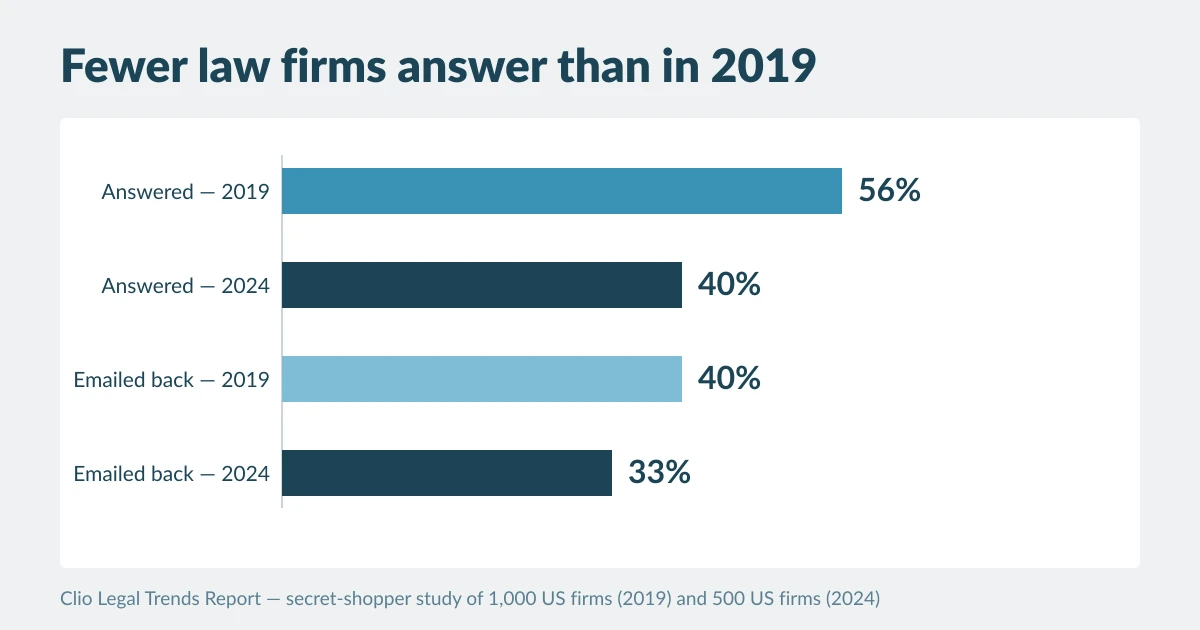
In 2019, a third-party research firm called 1,000 US law firms posing as prospective clients. A person answered 56% of those calls.
They ran it again in 2024 against 500 firms. That number had fallen to 40%.
Both rounds are Clio's Legal Trends Report, and the five-year direction is the part worth sitting with. Law firm missed calls are not a new problem, and the profession has not been quietly fixing it. It got worse — during a period when the cost of making that phone ring in the first place went up.
What the secret-shopper study actually found
Clio hired an independent research firm to contact law firms as interested clients, with inquiries tailored to each firm's practice areas: fees, procedures, experience, booking a consultation. The 2024 round covered 500 US firms.
- 40% answered the phone. Down from 56% in 2019.
- 33% replied to an email. Down from 40% in 2019.
- 48% were effectively unreachable by phone — they neither answered nor returned the call.
One caveat applies here and to everything else in this post. Clio sells practice management and client intake software, so it has a commercial interest in firms concluding they have an intake problem. What makes the study worth citing anyway is that it used an outside research firm, published its method, and repeated that method five years apart. That is a higher bar than nearly anything else published in this category. It is still not an independent audit. Treat it as the best available evidence rather than a finding of fact.
Half the firms in that sample were unreachable by phone. Not slow. Unreachable.
A missed intake call is a lost case, not a lost lead
This is where legal intake diverges from most industries, and it is why the usual "lost lead" framing understates it.
Someone calling a law firm generally has a live matter. They were rear-ended this morning. They were served on Friday. They have a hearing date, a closing date, a filing deadline, or a limitation period running against them. They are not browsing. They are going to retain counsel — the only open question is whose letterhead is on the engagement letter.
That changes the arithmetic of a missed call. In retail, a missed inquiry is a probability of a sale. In legal intake, a missed call is usually a matter that proceeds without you, because the caller's problem does not go away when your phone stops ringing. It gets solved by whoever answered.
Now add what it cost you to generate that call. In WordStream's 2025 Google Ads Benchmarks, Attorneys & Legal Services carried the highest average cost per lead of any industry tracked — $131.63, against a $70.11 average across all industries. (WordStream aggregates from advertising accounts it manages, so read it as a large sample of paid-search advertisers rather than a census of the profession.)
So: the most expensive lead in American advertising, and then a coin-flip on whether anyone picks up. That is the actual shape of the problem.
Why five minutes decides it
The best-sourced finding in this entire category is not about law at all, which is precisely why it holds up.
In the MIT Lead Response Management Study (Dr. James Oldroyd, MIT Sloan School of Management, with InsideSales.com, 2007), researchers analyzed more than 100,000 call attempts and found that responding within five minutes made a business roughly 100 times more likely to make contact and 21 times more likely to qualify the inquiry than waiting 30 minutes. (This is frequently misattributed to a 2011 Harvard Business Review article by the same lead author, "The Short Life of Online Sales Leads" — that piece reports different, smaller multiples: 7x and 60x.)
Thirty minutes. Not thirty hours.
Apply that to a Friday 5:15pm call about a matter that felt urgent enough to phone a law firm about. By Monday morning, that person has spoken to somebody. Your callback is not the start of a conversation, it is an interruption of one already underway somewhere else.
The number we are not going to give you
You will find a widely circulated figure putting the profession's annual loss to unanswered calls at $109 billion. It comes from a study by Law Leaders, released in August 2025, which placed 1,200 calls to small and mid-sized US firms between 10am and 4pm local time and found 34.8% went completely unanswered.
The 34.8% is a real measurement with a disclosed method, and it is consistent with the Clio direction. The $109 billion is not a measurement. It is that call volume multiplied by an assumed 7% conversion rate and an assumed $8,000 average client value — and neither assumption is sourced. It was also published by a company that sells software to fix missed calls.
We are not going to hand you a per-firm dollar figure either, and the reason is specific to law rather than a general reluctance to do arithmetic: there is no average case value worth multiplying by. A simple will and a catastrophic-injury claim are both "one case." A firm doing flat-fee immigration work and a firm doing contingency plaintiff work are not on the same scale by any factor you could pick. Any single number covering both is a number somebody invented.
You already hold the input we do not. Take your realization on the last twenty matters you opened, apply your own intake-to-engagement rate, and multiply that by the calls your phone system logged as unanswered. That figure is worth something. Ours would not be.
"But we don't want every call"
This is the real objection from a managing partner, and it is a fair one. Volume is not the goal. A tire-kicker who occupies forty minutes of a fee earner's afternoon is a cost, not an intake win.
Which is the argument for answering, not against it. Per Clio's Legal Trends Report benchmarks, the average lawyer's utilization rate sits around 37% — roughly 2.9 billable hours in an eight-hour day. A fee earner's hour is the scarcest thing your firm owns. The question is not whether to answer every call. It is whether the sorting happens before that hour is spent or after.
Right now, in most small firms, sorting happens either at the front desk during business hours or not at all. Everything arriving outside that window gets sorted by voicemail, which sorts on persistence rather than on merit.
Where an AI Employee fits this specific workflow
Two roles on our roster map onto legal intake, and it is worth being precise about which does what.
Ava is a Lead Conversion Coordinator. She takes the intake call — at 7pm, on a Saturday, during the hearing you are sitting in. She captures matter type, timeline and contact details, asks enough to separate an inquiry worth a fee earner's hour from one that is not, and books the consultation into the right diary. Not a message. A booked slot.
Tessa is a Client Engagement Coordinator, and legal is where she earns her keep. Legal decisions stall. Weeks pass between a first call and a signed engagement letter while someone talks to their spouse, waits on a police report, or decides they can afford it. Tessa holds contact across SMS and email through that gap, without anybody having to diarize it.
The limits, stated up front rather than discovered later:
- It does not give legal advice. It captures information and books time. The boundary is defined by you during setup.
- Conflicts and escalation stay human. Anything touching a conflict check, a limitation date, or a distressed caller routes straight to a named person with the transcript attached.
- It does not replace your front desk. It covers after-hours, overflow, and the repetitive procedural questions that consume a receptionist's morning.
Before you buy anything, secret-shop yourself
Clio's finding is only interesting if it describes your firm. It might not.
Do what their researchers did, on your own number:
- Export the last 30 days from your phone system. You want total inbound, answered, and unanswered. That ratio is your real number — not 40%, not 34.8%, yours.
- Check the timestamps. Missed calls cluster: lunch, Monday morning, and everything after 5pm.
- Have someone your staff will not recognize call your main line at 6:30pm on a Tuesday with a plausible inquiry. Then have them email the address on your contact page. Note what happens and how long it takes.
- Ask your intake person what currently happens to a voicemail left on a Saturday.
If you answer nearly everything and return the rest inside the hour, none of this applies to you. Close the tab.
If you found what Clio found, the fix is not a bigger ad budget on the most expensive keywords in America. It is answering the ones you already paid for.
Related reading: AI Employees for law practices, how the receptionist deployment works, and what it costs. The ROI calculator on this site is built on dental inputs — the structure of the arithmetic transfers to a law practice, the case-value figure does not, so substitute your own.
Frequently asked questions
How many law firms answer the phone when a prospective client calls? 40%, per Clio's 2024 Legal Trends Report, in which an independent research firm contacted 500 US firms as prospective clients. That is down from 56% in the same study run in 2019. A separate 2025 study by Law Leaders, placing 1,200 calls during business hours, found 34.8% went completely unanswered.
How much does a missed call cost a law firm? There is no defensible single figure, because case values in law range from a few hundred dollars to seven figures. Published estimates that quote one are multiplying by an assumed average client value that nobody has sourced. Use your own realization per matter and your own intake-to-engagement rate instead.
Does answering faster actually win more matters? The strongest evidence is not legal-specific. The MIT Lead Response Management Study (Oldroyd, MIT Sloan, 2007) found that responding within five minutes made contact roughly 100 times more likely, and qualification 21 times more likely, than responding after 30 minutes. The mechanism is the same regardless of industry: the caller is talking to someone else by the time you get back to them.
Can an AI Employee handle legal intake without giving legal advice? Yes, because it is scoped not to. It captures matter type, timeline and contact details and books a consultation. The boundary is set during configuration, and anything touching a conflict check, a limitation date, or a distressed caller routes to a named person with the transcript attached.