

Loan Officer Missed Calls: The Number Nobody in Lending Tracks

A contractor with a signed purchase order and a supplier asking for half up front starts calling lenders at 2:15 on a Tuesday. He gets a voicemail. Then a hold queue. Then someone who takes a message and promises a callback. Then a person who picks up. By 3:40 he has a term sheet from the fourth one.
The first three will never know he called.
That is the part that makes this different from every other missed-call article you have read. Three firms lost a live file that afternoon and recorded nothing. No lead in the CRM, no loss in the pipeline report, no line item anywhere. The month just came in lower than the one before and nobody could say why.
Lending calls expire faster than other calls
Most service businesses have a forgiving clock. A patient who reaches a dental practice's voicemail on Friday still has the same tooth on Monday. The demand does not go anywhere, and a callback on Tuesday recovers a real share of it.
A funding enquiry has a counterparty holding a stopwatch.
Three things run down at once in this business. A rate lock is the obvious one — the Consumer Financial Protection Bureau notes that locks "are typically available for 30, 45, or 60 days, and sometimes longer," which means the calendar starts on a fixed date whether or not anyone in your office has spoken to the borrower yet. Every day you spend not answering comes off a window somebody already paid for.
Then there is the deal underneath the loan. A purchase agreement has a closing date. An equipment order has a delivery slot. A supplier who wants a deposit this week does not care about your call-back queue. The borrower is not shopping for a lender in the abstract — they are trying to hit a date that already exists.
And third, they are asking more than one of you. Every loan officer knows this from their own pipeline. What does need saying: we could not find a defensible published figure for how many lenders a typical business borrower contacts on a single enquiry, so there isn't one in this article.
The lending missed-call statistic does not exist
Search for what a missed call costs a lending brokerage and you will find numbers. Trace them back and most turn into a general small-business figure, or a dental or home-services calculation, with the word "lender" swapped in.
We are not going to hand you one.
Here is the honest reason. To put a dollar figure on a missed funding enquiry you need three inputs: the share of your inbound calls that are new funding enquiries, the difference in close rate between an enquiry answered in minutes and one returned the next morning, and your own commission structure on a funded file. The first is yours. The third is yours. The second is the entire argument, and nobody has published it for lending.
Any article that gives you a number has invented the middle input. That is the whole trick, and once you have seen it you cannot unsee it.
What is actually sourced
One finding in this category has a retrievable study behind it.
Dr. James Oldroyd, in the MIT Lead Response Management Study (MIT Sloan School of Management, with InsideSales.com, 2007), analysed over 100,000 call attempts and found that responding within five minutes made a business roughly 100 times more likely to make contact and 21 times more likely to qualify the lead than waiting 30 minutes. (This is often misattributed to a 2011 Harvard Business Review article by the same lead author, "The Short Life of Online Sales Leads" — that piece reports different multiples, 7x and 60x.)
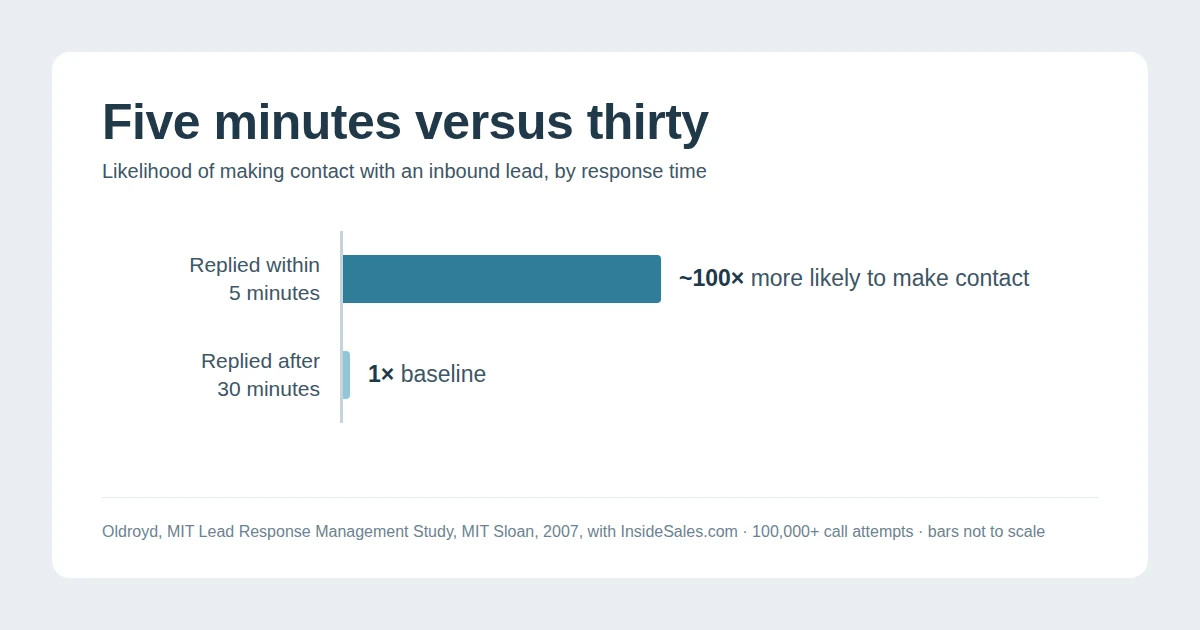
Read the comparison carefully, because it is stronger than people assume. The losing condition in that study is thirty minutes. Not the next business day — half an hour. A borrower who calls at 4:50pm and gets your voicemail is already well past the point the research measured.
Two caveats we would rather state than have you find. The study is from 2011, and it looked at online sales leads across industries, not lending files specifically. We use it because it is the only speed-to-contact finding in this space with a real paper behind it, not because it was written about you.
The borrower who reaches you first will often pay more to stay with you
This is the part loan officers tend to find genuinely surprising.
Reporting on the Federal Reserve Banks' Small Business Credit Survey, American Banker summarised the finding this way: "Among small-business owners who applied to an online lender, the top reason cited was the speed at which they anticipated receiving either a loan decision or the requested funding." A Fed researcher quoted in the same piece put it more bluntly — "We can tell from the factors that they cite in their choice of lender that they prioritize speed far above cost and interest rate."
We are not quoting a percentage alongside that, because the Federal Reserve's own report was not retrievable to verify one against, and a number we cannot check is worse than no number.
Now set it beside a figure from the same survey programme that we could verify. The 2025 Small Business Credit Survey was fielded from September to November 2025 and reached more than 6,500 small employer firms. Among firms that borrowed from online lenders, 60% reported higher-than-expected borrowing costs.
A majority of the borrowers who took the fast money found out afterwards that it cost more than they thought. They took it anyway. Speed was the thing they were buying.
To be clear about what that is and is not: the survey asked about online lenders, not brokerages, and reading the two findings together is our inference rather than a published conclusion. But it is not a stretch. The competitor who answered that contractor's call at 3:40 was very likely not beating you on rate.
Deal size is what changes the arithmetic
The Small Business Administration reported that in fiscal year 2025 it approved 77,600 7(a) loans for $37 billion. Divide one by the other and the average funded 7(a) file lands around $477,000.
That division is ours, not the SBA's — they published the totals, not the average — and 7(a) is a single product. Your mix of merchant cash advance, equipment finance and commercial real estate will not look like it.
It still makes the point. A dental practice missing a call is risking a first visit worth a few hundred dollars in chair production. A lending brokerage missing a call is risking points on a file the size of a house. You do not need a conversion-lift statistic to decide the phone is worth answering at that scale — which is exactly why we are not going to multiply it out and print a headline number. It would be enormous and it would be unearned.
Measure your own miss rate before you buy anything from anyone
Every article on this subject, this one included, assumes you have a problem. You might not.
Pull 90 days of inbound call logs out of your phone system. Nearly every VoIP platform exports this. You want total inbound, answered, unanswered, and timestamps.
Split the unknown numbers from the ones already in your CRM. In a lending office an unrecognised number skews heavily toward a borrower you have never spoken to — that ratio is your real exposure, not your overall miss rate.
Look hard at 4:30pm to 7pm, and at Saturday morning. A business owner researching funding does it after closing their own shop.
Then ask the question that actually decides this. Of the enquiries you answered inside five minutes last quarter, how many funded — against the ones you returned the next day? If your CRM cannot answer that, that is your finding, and no vendor can fix it for you.
Where an AI Employee fits
Ava is a Lead Conversion Coordinator. She captures the inbound enquiry instantly and runs the booking conversation end to end, which in lending means the amount sought, time in business, monthly revenue and use of funds are on the record from the first conversation — while the borrower is still comparing, not after your team has chased basic facts by email for two days.
Kai answers the process questions: what documents are needed, what happens next. Tessa keeps contact through the days a file sits in underwriting, which is where applicants get nervous and answer somebody else's call.
The limits, stated plainly. It does not make credit decisions — it collects and routes, and decisioning stays entirely with your underwriters, with the boundary set during configuration. SMS and voice contact run inside the consent and contact-window rules you set for your jurisdiction and product. And it does not repair a pipeline that loses files for other reasons. If your real problem is a three-week turnaround to close, answering faster only means the borrower leaves you later.
Run your own version of this
Take your own call log, your own answered-versus-returned close rates, and your own commission on a funded file. If the answer bothers you, book a demo and we will go through your actual call data on the call. If it doesn't, you have spent an afternoon confirming your phone is covered.
Related reading: AI Employees for business lending, the ROI calculator and the sources behind it, and what an AI receptionist actually does on a call.
Frequently asked questions
How much does a missed call cost a lending brokerage? Nobody has published a defensible figure, and we are not going to invent one. The calculation needs the close-rate difference between an enquiry answered in minutes and one returned the next day, and that number does not exist for lending. What is sourced is the mechanism: the MIT Lead Response Management Study's 2007 analysis of more than 100,000 call attempts found a five-minute response made contact roughly 100 times more likely than a thirty-minute one.
Why is speed more important in lending than in other service businesses? Because three clocks run at once — the rate lock, which the CFPB says typically runs 30, 45 or 60 days; the deadline on the deal the loan is funding; and the competing lenders the borrower contacted the same afternoon. A missed call in most industries is deferred demand. In lending it is frequently a file that funds somewhere else.
Do borrowers really choose speed over rate? Reporting on the Federal Reserve's Small Business Credit Survey, American Banker found that speed of decision or funding was the top reason small-business owners gave for applying to an online lender, with a Fed researcher stating that they "prioritize speed far above cost and interest rate." Separately, the 2025 survey found 60% of firms that borrowed from online lenders reported higher-than-expected borrowing costs. Draw the connection yourself.
Does an AI Employee replace a loan officer? No. It answers and qualifies the enquiry so a licensed person is talking to a real file instead of chasing a voicemail. Credit decisions stay with your underwriters.