
The After-Hours Booking Window Med Spas Are Losing to Voicemail
A consultation enquiry lands at 9:40 on a Tuesday night. Someone has been scrolling for forty minutes, seen a before-and-after, and decided tonight is the night they finally ask about it.
Your front desk went home at six.
What happens over the next twelve hours is the whole question. The aesthetics industry has decided to answer it with statistics that mostly do not exist. We went looking for a real number on med spa after-hours bookings. Here is what we found, what we could not verify, and what you should measure instead.
What is actually sourced
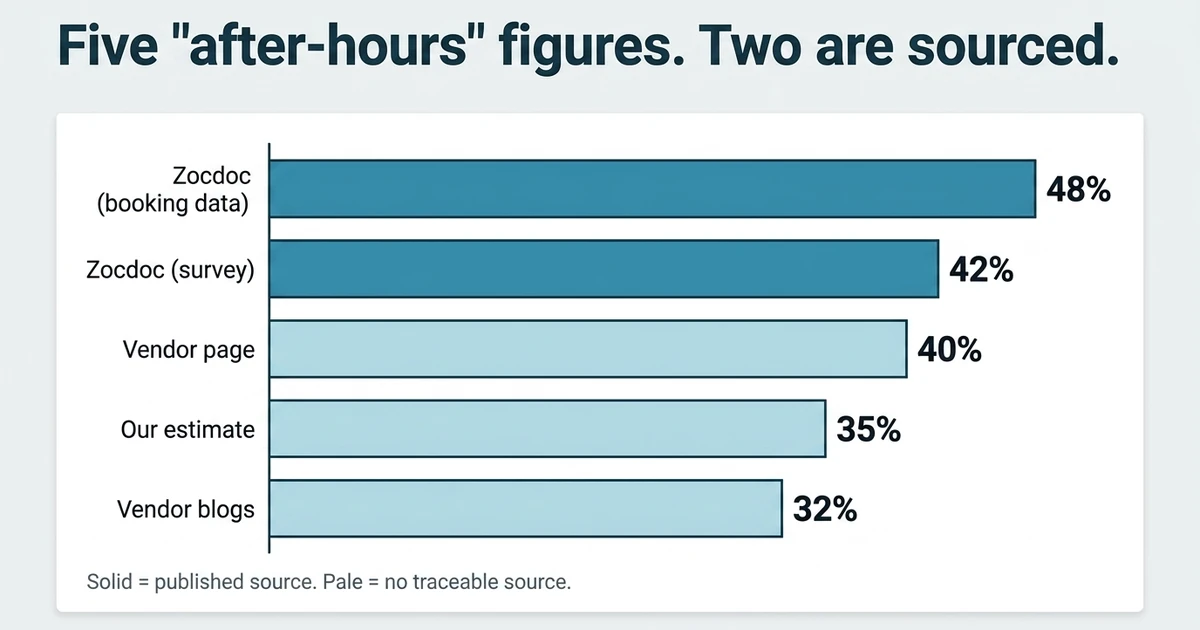
The strongest published figure on after-hours booking in healthcare comes from Zocdoc. In its inaugural What Patients Want report, 48% of appointments booked through Zocdoc were booked when doctors' offices are usually closed (reported December 2023). Zocdoc's own guidance for providers defines that window as 5pm to 9am and describes the share as "roughly half."
That is platform booking data across millions of appointments rather than a survey, which makes it more useful than almost anything else in this category.
Two honest problems with it. First, it covers all of healthcare — primary care, dermatology, dentistry, therapy. Med spas are not broken out. Second, Zocdoc's 2024 report puts the figure at 42%, but that number comes from a 1,000-person Censuswide survey asking people what they remember doing, not from booking logs. Two Zocdoc numbers, two methods, six points apart. They are not the same measurement and should not be averaged into one.
The closest thing to a sector-specific figure comes from Zenoti's 2025 Benchmark Report: 81% of salon and spa regulars need to manage appointments outside typical business hours at least sometimes. Zenoti sells booking software to salons and spas, and the published summary discloses no sample size, no geography, and no field dates. Directionally interesting. Not a measurement to plan around.
The med spa numbers everybody quotes
Search this topic and you will be handed a set of confident figures:
- 40% of spa appointments are booked after business hours
- 32% of spa bookings happen after hours
- The average med spa visit is worth $527
- 79% of med spa clients abandon a booking if it is slow
- Med spas lose over $100,000 a year to missed calls
We tried to trace each one.
The 40% appears on a software vendor's product page, introduced with "industry data shows" and followed by no study, no sample, no link. The 32% appears on vendor blogs citing other vendor blogs. The $527 — elsewhere $536 — is attributed to the American Med Spa Association, whose State of the Industry Report is real and is the best data anyone has in this sector. It also costs $995, so we cannot verify what that number counts or which year it covers. AmSpa's public page states industry revenue above $17 billion and nothing more granular. The 79% has no visible origin at all.
The $100,000 figure traces back to a press release issued by a company selling AI receptionists to med spas.
We sell AI employees to med spas. That last one is our own category making a claim about our own value, and it is the least sourced number on the list.
So, plainly: there is no published, retrievable study of med spa after-hours enquiry share. Anyone who quotes you one is estimating. That includes us.
What we use instead, labelled as what it is
Our ROI calculator uses 35% as the after-hours share, tagged in the interface as an editorial estimate — the midpoint of a range running from about a quarter to nearly half, which is as much as the evidence supports.
It is also editable, and it never changes the total. It only decides how the recovered revenue splits between two AI Employees. We built it that way on purpose, so that the number we cannot source cannot quietly inflate the number we show you.
Why aesthetics should skew later than the rest of healthcare
Nobody has measured this. But there are three structural reasons to expect a med spa's after-hours share to sit at the top of that range rather than the bottom, and they are worth stating as reasoning rather than as data.
Nobody researches injectables on the clock. A root canal is an interruption to your day. A filler consultation is a personal project — discretionary, self-funded, appearance-related, and researched on personal time, on a personal phone, with the door closed.
The trigger is visual, and it lives where people are at night. A systematic review published in Cureus — Mironica and colleagues, July 2024, covering 25 studies and 13,731 participants — found that 37.8% of respondents expressed a desire for a cosmetic procedure because of selfies, and that 76.1% of rhinoplasty patients said before-and-after images influenced their decision. That review is about what drives the decision, not when. But the medium doing the driving is the medium people consume in bed.
It is not a conversation most people want to have at work. A dental appointment gets booked openly from a desk. An enquiry about something you would rather not explain to a colleague gets made from the sofa.
None of that measures your enquiry timing. It argues that your after-hours share is probably higher than a family doctor's. Your phone log is what settles it.
The window is short, and this part is measured
The response-time research is real. The way it gets cited is a small case study in this article's own subject.
The figures — a five-minute response making contact roughly 100 times more likely, and qualification 21 times more likely, than a thirty-minute one — come from the MIT Lead Response Management Study (Dr. James Oldroyd, MIT Sloan, 2007, with InsideSales.com). It examined three years of data across six companies, more than 15,000 leads and over 100,000 call attempts.
You will almost always see those two numbers credited instead to a 2011 Harvard Business Review article, "The Short Life of Online Sales Leads." That article exists, it shares an author, and it did more than anything else to popularise the five-minute rule. Its own reported multiples are 7× and 60×, measured against one-hour and 24-hour delays. The 100× and the 21× are not in it. Same researcher, different study, fused together by a decade of retelling.
The correction does not weaken the finding. It just puts the right name on it.
Thirty minutes. Not thirty hours. A 9:40pm enquiry that gets a reply when the doors open at nine the next morning sits eleven hours outside a window measured in minutes.
One more to discard: "78% of patients book with whoever responds first" is attributed to the HBR article about as often. It is not in that one either. Both studies measure contact and qualification rates, not booking share — and neither needs the embellishment.
The other half of the problem: the decision takes months
Speed gets you into the conversation. It does not finish it.
Elective aesthetic treatment is a considered purchase. The person who enquires at 9:40pm on a Tuesday may not book until eleven weeks later, after they have compared three clinics, checked their calendar around a wedding, and worked out what they are willing to spend. Both things are true at once: the enquiry expires in minutes, the decision takes months.
Most practices fail one end or the other. They miss the enquiry entirely, or they catch it, send a single follow-up, and quietly abandon the sequence by week two — which is usually a few weeks before the decision actually gets made.
What Ava and Tessa do about it
Ava takes the first half. She answers the 9:40pm enquiry while the phone is still in the person's hand, across voice, SMS and web form, qualifies which treatment they are asking about, and books the consultation into your calendar. Tessa takes the second half — the personalised follow-up sequence that runs across weeks and months, over SMS and email, without anyone at the front desk having to remember it exists.
To be straightforward with you: this does not replace your front desk. It covers the hours your front desk is not there and the follow-up nobody has time to sustain.
It also will not fix a practice losing patients for other reasons. If your consultations do not convert, if your pricing does not survive the room, if the next available injector appointment is four weeks out — answering faster just gets you more of the same conversation. Speed is worth a great deal when the rest of the operation is sound, and very little when it is not. We would rather say that now than after you have signed something.
Treatment enquiries are health information and are handled as such: every medical practice client gets a signed BAA before any patient data moves through the system.
Measure your own, before you buy anything
Every article on this subject, this one included, assumes you have an after-hours problem. Find out whether you do.
- Export 90 days of call logs — total inbound, answered, and timestamps. Ninety days rather than thirty, because aesthetics has real seasonality and a January sample will not look like a September one.
- Bucket them by hour. Count everything between 6pm and 9am, then add the whole weekend. That is your genuine after-hours share. Not 35%, not 48%. Yours.
- Add the channels the phone log cannot see. Instagram DMs, Facebook messages, website form fills. In aesthetics this is often the larger half of inbound volume and it is invisible in a phone report. Pull the timestamps on your last 50 form submissions.
- Time your actual response on the after-hours ones. Enquiry timestamp to first real human reply. The autoresponder does not count.
- Ask your team what happens to a Saturday enquiry — then check what happened to last Saturday's.
If your after-hours share comes in under 15% and you are replying inside the hour, none of this applies to you. Close the tab.
Run it against your own numbers
Take your real after-hours share from the exercise above and put it into the ROI calculator in place of our 35% estimate. If the result is a number that bothers you, book a demo and we will go through your actual enquiry data together on the call.
Related reading: AI Employees for med spa practices.
Frequently asked questions
What percentage of med spa appointments are booked after hours? No published study measures this for med spas specifically. The best adjacent figure is Zocdoc's, which found 48% of appointments across healthcare were booked when offices are usually closed. Widely circulated med spa figures of 32% and 40% have no traceable source. We use 35% as a labelled estimate and recommend you replace it with your own phone log.
How fast do you need to respond to a med spa enquiry? Within five minutes, based on the MIT Lead Response Management Study (Oldroyd, MIT Sloan, 2007), which analysed over 100,000 call attempts and found a five-minute response made contact roughly 100 times more likely than a 30-minute one. Note that this finding is widely misattributed to a 2011 Harvard Business Review article, which reports different multiples. The research is also not aesthetics-specific — no aesthetics-specific equivalent has been published.
Does an AI receptionist fix after-hours enquiries? It covers the enquiries that go unanswered because nobody is there — evenings, weekends and overflow — and sustains the long follow-up that decides an elective purchase. It does not improve a consultation that is not converting, and it does not create appointment availability you do not have.