
Why Coaching Leads Go Cold in the First 48 Hours

Forty-eight hours is our framing, not a measured cliff. Nobody has published a study of how fast a coaching lead decays, and we're not going to pretend otherwise in the opening line of an article about being honest with numbers.
What has been measured is a window much shorter than 48 hours, and a sequence much longer than it. Almost every article on this topic covers one of those clocks and ignores the other. The gap between them is where coaching practices lose people.
The short clock: five minutes, and it's the only one with a real source
The MIT Lead Response Management Study (Dr. James Oldroyd, MIT Sloan School of Management, with InsideSales.com, 2007) analyzed more than 100,000 call attempts and found that responding within five minutes made a business roughly 100 times more likely to make contact and 21 times more likely to qualify the lead than waiting 30 minutes. (This is frequently misattributed to a 2011 Harvard Business Review article by the same lead author — that piece reports different multiples, 7x and 60x.)
Thirty minutes. Not thirty hours.
Two things that study did not do matter more than the headline. It measured contact and qualification, not closed deals. And it was industry-agnostic — there is no coaching cohort in it. Anyone quoting it as "coaching leads die in five minutes" is extending it past what it says.
It tells you one thing clearly: whoever replies first has an enormous structural advantage over whoever replies second. For a discovery-call form or a lead-magnet download, that advantage is sitting there on a Saturday night, when the person filling in the form is at their most motivated and you are not at your desk.
The long clock: eleven touches over 22 days
A coaching sale isn't a single missed phone call. Someone downloads your framework, reads it, thinks about it, and decides months later — or never — depending largely on whether anyone stayed in the conversation.
The best-documented version of that sequence is Velocify's Ultimate Contact Strategy sales optimization study, built from nearly 3.5 million leads across more than 400 companies, generated in the first half of 2012 and tracked to the end of that year's third quarter. On persistence, it found:
- 93% of all converted leads are contacted by the sixth call attempt. Only 7% are first reached after seven or more.
- Leads that take seven or more calls to reach are 45% less likely to convert than those reached in six or fewer.
- The optimal number of emails in a prospect's first month is five. Send more than five before making contact and conversion drops 36% against those reached after one to five.
- 50% of leads are never called a second time.
- 59% of prospects were never sent a single email — and about 40% of the prospects who did have an email address on file were never emailed at all.
Laid out on a calendar, the schedule that study recommends looks like this:
| When | Touch |
|---|---|
| 0–1 minute | Call 1 |
| 20 minutes | Email 1 |
| 30–60 minutes | Call 2 |
| 1–2 hours | Call 3 |
| Day 4 | Email 2 |
| Day 5 | Call 4 |
| Day 8 | Email 3 |
| Day 14 | Call 5, Email 4 |
| Day 15 | Call 6 |
| Day 22 | Email 5 |
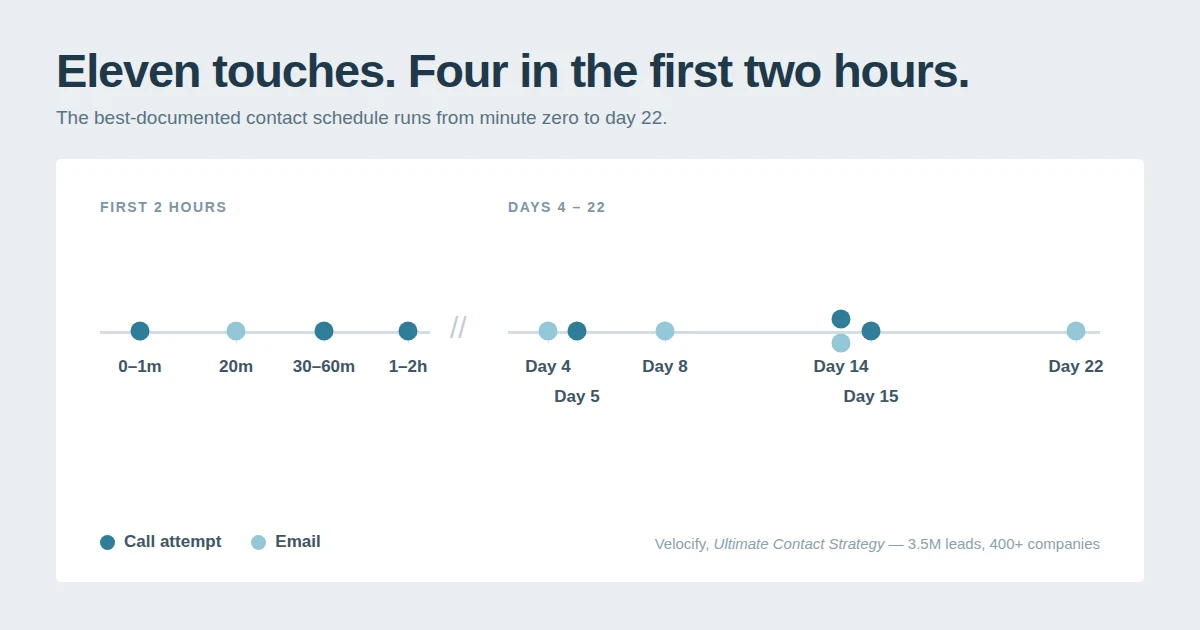
Eleven touches. Four of them land in the first two hours. The last one is three weeks out. Both clocks, in one dataset — which is the point, and the thing a speed-to-lead article and a nurture-sequence article each tell you half of.
Now the caveats, because this study is a vendor's. Velocify sold lead-management automation, the sample was drawn from its own client base, the data is from 2012, and the report closes by recommending you buy software that runs the schedule for you. It also attaches conversion lifts to that schedule — 391% from a one-minute first call, 128% from the full sequence. Those are aggregates the vendor computed across its own customers, and we're not repeating them at you as a promise. The persistence findings are structural and useful. The lift percentages are marketing.
To its credit, the study says plainly that its results aggregate hundreds of organizations across many industries, and that the right strategy depends on the individual business. There is no coaching cohort in it either.
So treat the 22-day schedule as the shape of the problem, not a prescription for a $12,000 engagement. A coaching sale routinely runs longer than that. How much longer, nobody has published — so we don't have a number for you.
The follow-up statistic we're not going to quote
You have seen this one: 80% of sales require five follow-up calls after the meeting, and 44% of reps give up after one. It is everywhere in coaching and consulting content, usually credited to the Brevet Group.
We went to find the study. The Brevet page it traces to is a list titled "21 Mind-Blowing Sales Stats," now hosted by SBI, which presents all 21 figures with no citation, no link and no named source. The other common attribution is a page on an advice site called Marketing Donut, which no longer exists. Every downstream citation treats one of those two as original research. Neither is.
So there's no percentage here. What we can hand you instead is Velocify's number, from a study that publishes its methodology: half of all leads are never called a second time. That isn't a claim about buyer psychology. It's a count of follow-up that didn't happen.
Why this lands harder on a solo coaching practice
The 2025 ICF Global Coaching Study, conducted by PwC Research from 10,035 valid responses collected between February and April 2025, gives the real shape of a practice:
- Active coach practitioners charge an average of $234 for a one-hour session
- They work an average of 11.6 hours per week as a coach
- They carry an average of 12.4 active clients
- They earn an average of $49,283 a year from coaching activities
One warning before anyone builds a revenue model on those. They don't multiply. $234 × 11.6 hours × 52 weeks comes to roughly $141,000 — nearly three times the $49,283 the same study reports. They are averages over different subpopulations, and any article that multiplies them has invented a number. It's the most common way coaching statistics go wrong.
What they do support: at 12.4 active clients, one client is about 8% of your entire book. Losing one to a follow-up that never happened is not a rounding error.
And the 11.6 hours is delivery. Pipeline work happens in the hours around it, unbilled and unscheduled, which is why it stops first when delivery gets busy. That isn't a discipline problem. It's what happens when the person doing the coaching is also the person meant to send the day-14 email.
The same study found 59% of coaches expect revenue growth this year, mostly from more clients (60%) and more sessions (51%). It also found only 19% invested in new technology in the past year, and 37% named adapting to technology as a major concern. More clients, same hours, same tools.
Measure your own decay before you buy anything
Every article in this category, this one included, assumes you have a follow-up problem. Check before you spend:
- Export the last 90 days of inquiries and record, for each, when it arrived and when you first replied. Use the median — one 4am reply flatters a bad month.
- Count the touches for every prospect who didn't book. Most solo practices find the number is one.
- Open your "not right now" list. When did each person last hear from you? If the honest answer is "never again," that's your finding.
If your median first response is under an hour and your not-yet list gets contacted monthly without fail, none of this applies to you. Close the tab.
Where an AI Employee actually fits
Two of ours cover the two clocks. Ava takes the inquiry the minute it lands — evenings, weekends, mid-session — qualifies it and books the discovery call into your calendar, with your buffers and delivery blocks respected. Tessa runs the long half: personalized follow-up sequences across SMS and email that hold a prospect for weeks and months without anyone remembering to chase.
Being straight about the limits. Neither one does your sales conversation — the discovery call is still you. Neither fixes a weak offer, unclear positioning, or a lead magnet attracting people who were never going to buy. And if you get three inquiries a month, the arithmetic doesn't justify it. We'd rather say that now than after you've signed something.
Run your own version
Put your median response time and your touch count against the eleven touches over 22 days. The gap is the work nobody is doing. If it bothers you, book a demo and we'll look at your actual inquiry log on the call. If it doesn't, you've spent ten minutes confirming your follow-up beats most.
Related reading: AI Employees for business coaches and the ROI calculator, which shows its sources and names the one input it can't defend.
Frequently asked questions
How fast should a coach respond to a new lead? The only finding with a retrievable source behind it is the MIT Lead Response Management Study's 2007 analysis of over 100,000 call attempts: replying within five minutes made contact roughly 100 times more likely, and qualification 21 times more likely, than waiting 30 minutes. It measured contact and qualification, not closed coaching engagements, and there was no coaching cohort in it.
How many follow-ups does it take to convert a coaching lead? Nobody has published a coaching-specific figure, and the widely-quoted "80% of sales require five follow-ups" has no traceable study behind it. The nearest defensible number is Velocify's, from nearly 3.5 million leads: 93% of converted leads were contacted by the sixth call attempt, and leads needing seven or more converted 45% less often.
Is 48 hours really the window for a coaching lead? No — that's a framing, not a measurement. What is measured is a five-minute first-response effect and an eleven-touch sequence running out to day 22. We use 48 hours as shorthand for the stretch where both matter and most practices do nothing.
Will an AI Employee replace my discovery calls? No. It books them, reminds both sides, and keeps the not-yet prospects in contact for the months they take to decide. The coaching conversation and the sales conversation are still yours.