

Real Estate Missed Calls: Brokerages Are Still Losing Buyers to Voicemail

A buyer finds your listing at 7:40 on a Saturday evening, likes what he sees, and calls the number on it. Nobody picks up. He doesn't leave a message. He goes back to the tab he came from and calls the next number.
The usual version of that story ends with "and that's a lost lead." In residential real estate it ends somewhere worse than that, and the reason is one number in the National Association of REALTORS®' own survey data.
Seventy-five percent of buyers interview one agent
NAR's 2025 Home Buyers and Sellers Generational Trends report, Exhibit 4-6, asked buyers how many real estate agents they interviewed before choosing one. Seventy-five percent interviewed exactly one. Another 16% interviewed two.
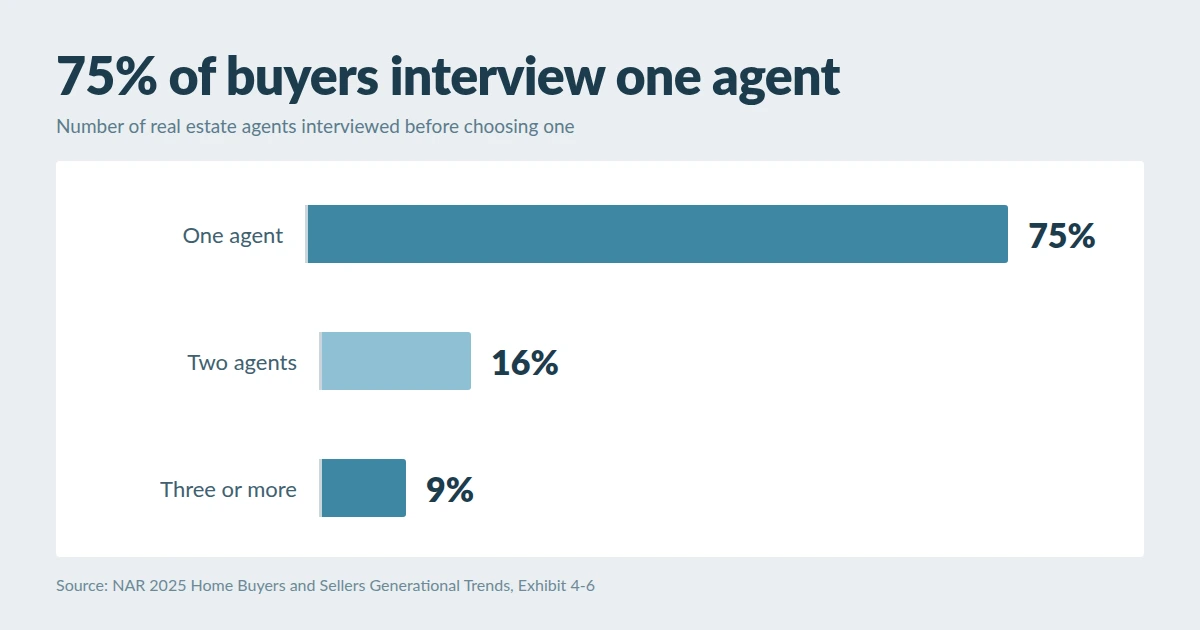
That means roughly nine out of ten buyers made their decision after talking to two people or fewer.
Most brokerages picture the competition as a bake-off — three agents pitch, the best one wins on experience, marketing plan, or commission structure. For three quarters of buyers, that bake-off never happened. Somebody answered, the buyer decided that person was their agent, and the search stopped.
Which reframes the missed Saturday call. You didn't lose a comparison. You lost the only round there was going to be.
The responsiveness paradox, and why it isn't one
Here's where the same report gets genuinely interesting, and where most articles on this topic quietly pick whichever number suits them.
Exhibit 4-8 asked buyers which agent qualities they considered "very important." Responsiveness came in at 95% — second only to honesty and integrity at 98%, and ahead of knowledge of the purchase process (93%), knowledge of the real estate market (91%), communication skills (88%), and negotiation skills (84%).
Then Exhibit 4-7 asked a different question: what was the most important factor when choosing your agent? "Agent is timely with responses" came in at 5%. Agent's experience took 23%, honest and trustworthy 19%, reputation 15%.
So responsiveness is near-universally rated critical, and almost nobody names it as the deciding factor. Those two findings get quoted separately by people arguing opposite cases.
They aren't in conflict. You can only pick an agent for their responsiveness if you had two agents to compare — and 75% of buyers didn't. By the time a buyer is weighing experience and reputation, the field has already narrowed to one, and responsiveness is what narrowed it. It isn't the tiebreaker. It's the qualifier that decides who gets into the room where experience and reputation are discussed at all.
When these calls actually arrive — and what I can't tell you
The obvious next question is what share of real estate inquiries land outside business hours. There is no retrievable dataset breaking residential inquiry volume down by hour of day. Plenty of vendor blogs will hand you a percentage; none cite anything you can trace. So there's no number here — inventing one would undermine everything else on this page.
What is sourced points the same direction:
- Zillow Research found homes listed on a Thursday go pending faster than any other day, and homes listed Sunday sat roughly eight days longer than Thursday listings. That analysis used 2019 data — pre-pandemic, and Zillow's own platform data, so treat it as directional rather than independent. The implied mechanism is simple: buyers plan their weekend around what appeared Thursday.
- NAR Exhibit 4-9 found 68% of buyers want to be notified as soon as a property is listed or the price changes, and 71% want their agent to call them personally about activity. That's an expectation of immediacy, measured.
- And there's plain arithmetic, which needs no citation at all. A week has 168 hours. A brokerage staffing standard hours covers something like 45 of them. The remaining 120-odd hours are exactly when a buyer with a weekday job is free to look at listings and free to call about one.
None of that proves a percentage. It doesn't need to. The shape of the problem holds without one.
Why this is a commission, not a lead
A missed call in most service businesses costs you a transaction. In a brokerage it costs a share of a six-figure sale — and it may cost the listing side too, because the buyer you didn't answer in July is a seller in eleven years. NAR's 2025 Profile of Home Buyers and Sellers puts median tenure before selling at 11 years, an all-time high, and reports 91% of sellers used an agent while only 5% sold FSBO, a record low.
Now the part that will disappoint you: there's no dollar figure here.
To calculate one honestly I'd need a standard commission rate, and there isn't one to quote anymore. Since the NAR practice changes took effect in August 2024, compensation is negotiable and buyer-side compensation is decoupled from the listing. Any article multiplying missed calls by "3% of the median home price" is quoting a convention that no longer describes the market.
Use your own numbers instead:
| Step | Your input |
|---|---|
| Missed calls per week | from your phone system log |
| × 52 | annual missed calls |
| × share that are new buyer or seller inquiries | not all of them — most are transaction traffic |
| × share that would have converted | your actual inquiry-to-client rate |
| × your average gross commission per closing | yours, not a national average |
And one honest correction to how that math usually gets presented: a missed call is not a lost commission. It's a lost chance at one. If your inquiry-to-client rate is 12%, an average missed new-buyer call is worth 12% of a commission, not 100% of one. The smaller number is the one you can defend to your accountant, and it's usually still large enough to matter.
Two statistics I'm not going to repeat
The first: "78% of buyers work with the first agent who responds." The most-repeated claim in this category, attributed variously to NAR, to Harvard Business Review, and to nobody in particular. Every citation leads to another article citing another article, and it doesn't appear in the NAR reports quoted above.
The second: the average agent takes 917 minutes to respond to a lead, usually credited to an Inman technology survey. Every instance sits on a vendor blog with no link to the original, and I couldn't retrieve the survey.
Both would have made this post punchier. Neither survives being checked.
What is sourced about speed
One finding in this area does hold up, and it's the one Client 4 Life AI leans on everywhere: the MIT Lead Response Management Study (Dr. James Oldroyd, MIT Sloan School of Management, with InsideSales.com, 2007) analyzed over 100,000 call attempts and found that responding within five minutes made a business roughly 100 times more likely to make contact, and 21 times more likely to qualify the lead, than waiting 30 minutes. (This is often misattributed to a 2011 Harvard Business Review article by the same lead author — that piece reports different multiples, 7x and 60x.)
It isn't real-estate-specific, and it's fifteen years old. It's also the only speed-to-lead finding in general circulation with a retrievable study and a stated sample behind it, which is why it's here and the 78% figure isn't.
Thirty minutes. Not thirty hours. The buyer who reached your voicemail at 7:40 on Saturday was, by Monday morning, someone else's client.
Where an AI Employee actually fits
Two of the AI Employees on the roster do the work this problem describes.
Ava answers the call. She picks up the Saturday evening inquiry, qualifies whether the caller is a buyer, a seller, or a neighbour checking comps, and books the showing into the calendar your team already works from — while the buyer is still holding the phone and still looking at the listing. That's the entire mechanism. It isn't clever. It's answering, at the hour when the one-agent rule decides the outcome.
Tessa handles the part everyone underestimates. NAR puts the median home search at 10 weeks. Most buyers who call about a listing aren't ready that week, and they go cold because staying in touch with a not-yet buyer for two and a half months is the first task dropped when a brokerage is busy closing. Tessa runs that follow-up across SMS and email for as long as the search takes.
The limits, plainly: this doesn't replace agents and it doesn't show the house. Anything touching negotiation, disclosure, or advice routes to a named person with the transcript attached. And if your brokerage misses two calls a week, the math doesn't justify it.
Before you believe any of this
Pull the call log from your phone system for the last 90 days. You want total inbound calls, answered calls, and timestamps.
Divide unanswered by total — that's your real miss rate, not a number from an article. Then look at when the misses cluster. If they're spread evenly across Tuesday afternoons, you have a staffing problem and this isn't the fix. If they stack up Thursday through Sunday and after six, that's the gap this is built for.
If your miss rate is under 10%, close the tab. Your team is answering the phone.
If the number bothers you, run it through the ROI calculator or book a demo. Real estate is one of the industries we build for, and the arithmetic we published for dental practices and their missed calls applies here with bigger units and a longer fuse.
Frequently asked questions
How many real estate agents does a buyer typically interview? One. NAR's 2025 Home Buyers and Sellers Generational Trends report (Exhibit 4-6) found 75% of buyers interviewed a single agent before choosing, and 16% interviewed two. Roughly nine in ten decided after talking to two people or fewer.
Do home buyers actually care about response time? As a quality, yes — 95% rated responsiveness "very important," second only to honesty and integrity. As a stated reason for picking one agent over another, only 5% named it. Both figures are from the same NAR report, and they aren't contradictory: most buyers never had a second agent to compare against, so responsiveness decided who they spoke to rather than who they preferred.
What percentage of real estate calls come in after hours? There is no published, traceable figure, and this article deliberately doesn't invent one. Your own phone log timestamps are the only reliable answer for your brokerage.
Does an AI receptionist work for a real estate brokerage? It covers the specific failure where an inquiry arrives outside staffed hours and reaches voicemail. It doesn't fix a brokerage losing clients for other reasons — thin inventory, weak listing presentations, or agents who don't follow up on leads they did receive.